OnchainSuite: architecture, product and half the bill
Retention and CRM software for blockchain teams: see which wallets are about to leave, and win them back by email and in-app message.
- Role
- Software Engineer
- Timeline
- Oct 2025 to now
- Status
- Live at onchainsuite.com
- Stack
- NestJS, Next.js, Postgres, Redis, Docker, Coolify, DigitalOcean
- Problem
- Web3 teams have on-chain data but no way to act on it, and the platform had to grow without its costs growing with it.
- What I did
- Shaped the architecture and backend foundation, own the web app from design choices to UX with the product owner, moved production to a self-hosted VM that scales vertically, and review every pull request before it ships.
- Result
- Hosting costs down 58%. About 10 organizations use it, and partners such as Surgence Labs and Vault777 run it for their own customers.
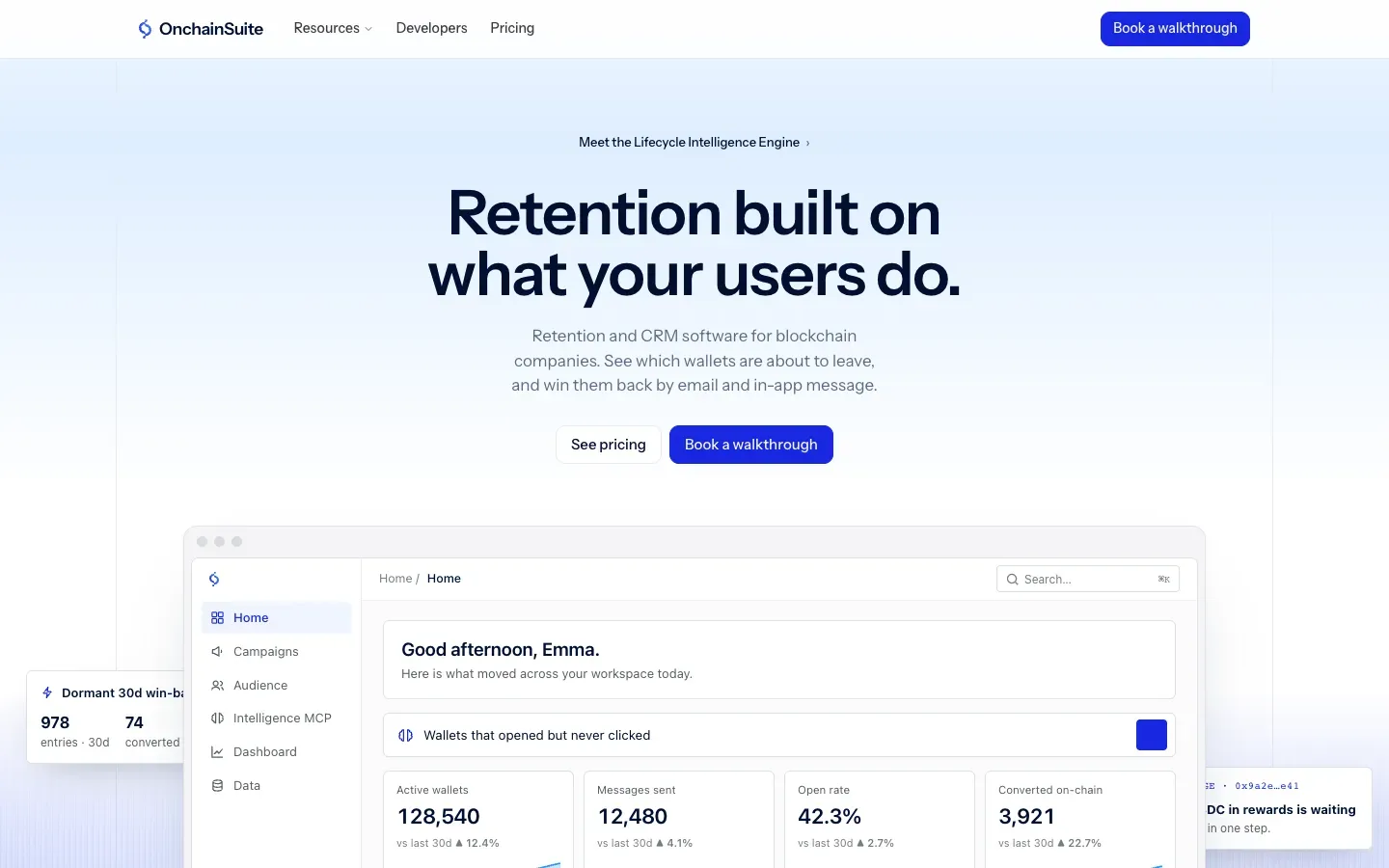
The system
Web3 teams have rich on-chain data and almost no way to act on it. OnchainSuite joins wallet activity, contract events and holdings with lifecycle messaging, so a growth team can segment by what users actually do on-chain, trigger campaigns and automations, and measure the result. It ships as three products in one workspace: R3tain for retention email and automations, Onch3n for on-chain analytics and intelligence, and 3ridge for wallet and identity auth. Some of its biggest users are also partners: Surgence Labs and Vault777 run campaigns through it for their own customers.
I joined in October 2025 and have worked across the whole stack since: the platform's architecture and backend foundation, the web product, the infrastructure it runs on and what it costs, and the review and release flow.
Software Engineer since October 2025. I helped shape the platform's architecture and laid its backend foundation. I started the web app and built much of the 2026 product on it: campaigns, automations, audiences, the email and form builders, intelligence, settings and the blog. I cut the hosting bill by 58% with a self-hosted VM designed to scale vertically, swapped costly vendors for cheaper ones, and review the team's pull requests before they ship. Teammates wrote most of the chain ingestion and the AI layer.
- hosting cost cut
- 58%
- organizations using it
- 10
- costly vendors replaced
- 4
The platform at a glance. Hover or tap a node.
An architecture that starts on one box
Dockerfile + main.ts (simplified)
ENV PROCESS_ROLE=all # web | worker | allCMD node --max-old-space-size=$NODE_HEAP_MB dist/main.js if (role !== "worker") await app.listen(port);if (role !== "web") startWorkers(env.QUEUE_PROCESSOR_GROUPS);
One Docker image can start as web, worker or both.
I laid the backend's foundation as a NestJS modular monolith: queue, cache, throttling, structured logging and health modules, a hardened bootstrap (security headers, compression, body limits, global validation and error handling), and the code-structure plan that keeps features in modules and shared infrastructure in one place, each module with its own README and API contract.
The deployment shape follows from it. One Docker image starts as the API, the worker or both, chosen by an environment variable. That lets the whole platform run on a single right-sized machine and grow vertically, with a bigger box, a larger Node heap and more queue processor groups, before anything needs to be distributed. When the worker does need its own machine, it moves without a code change.
PROCESS_ROLE, NODE_HEAP_MB and QUEUE_PROCESSOR_GROUPS in the Dockerfile and bootstrap, and a written code-structure plan.
Less than half the hosting bill
Before: managed hosting, managed Postgres and a paid WAF.
Production ran on managed services: Render for the app, Neon for Postgres and AWS for the WAF and email. I moved it to a self-hosted DigitalOcean VM running Coolify, with Postgres, pgvector and Redis on the same box and Cloudflare's proxy doing the WAF's job for free. Hosting now costs 58% less, with room to scale up before it costs more.
Moving production safely took a runbook, which I wrote so anyone on the team could run it. DNS TTL goes down first, queued jobs drain, and the worker stops before the web service so no job writes to a database that is being copied. Then dump, restore, verify, baseline migrations, deploy, and check health and webhooks before DNS moves, with the old host kept on standby for rollback.
A written cutover runbook and a hosting cost model.
Cheaper data and delivery
The biggest variable costs were vendors, so I moved them to cheaper paths. On-chain activity moved from GoldRush streaming to Alchemy webhooks and our own indexer, removing a streaming cost that grew with every new customer. Email consolidated on SendGrid and SES, retiring Azure Communication Services.
Each move kept the product's behaviour the same: the same events reach automations, the same campaigns go out. Only the bill changed.
The whole product surface
A visitor signs up with email or a social account.
I started the web app from its first commit: sign-up and multi-step onboarding, the guarded dashboard shell, and the first interfaces for R3tain, 3ridge and Onch3n. Through 2026 I built a large share of the product on top of it: campaigns, a full automations revamp, audiences with suppressions and live sync, the intelligence views, an email builder with a block and style document model, a form builder with wallet-first hosted pages, settings, passkeys and two-factor auth, team invites, resumable onboarding, billing screens and the landing site's free tools.
I own the web app day to day, which means the design choices and UX calls, made with the product owner, as much as the code. The rest of this page goes deeper on the pieces with the most interesting engineering behind them.
The web app's history from its first commit, October 2025 to October 2026.
Shipping a busy team's work
Teammates open pull requests against dev.
A small team moving fast produces a lot of pull requests. I review each one before it merges, across both the API and the web app. Merged work lands on dev, then promotes in batches to staging and then production.
Very few merges need hand-resolved conflicts, because branches are kept small and current.
Publishing without a deploy
posts.hooks.ts (simplified)
beforeChange: ({ data, req }) => { if (data._status === "published" && !isAdmin(req.user)) throw new Forbidden("Editors can only save drafts");},afterChange: ({ doc }) => { revalidateTag("posts"); revalidatePath(`/blog/${doc.slug}`);},
An editor writes a post. Editors can save drafts.
Marketing copy lived in components, so every wording change needed a pull request and a deploy. I added a Payload CMS inside the Next.js app with its API mounted away from the platform's /api/v1, so the two never collide.
There is no second login: a custom auth strategy forwards the visitor's OnchainSuite session to the backend and admits only admin roles, mirrored as read-only users with no password columns. Editors can draft but not publish, enforced by a hook rather than a hidden button, and publishing revalidates the static page in-process, so a post is live in about a second. Media is filed per post by walking the rich-text tree, and deleting a post only removes images nothing else still uses.
Decisions worth defending
Scale up before scaling out
One right-sized box is cheaper and simpler to run than a fleet the workload does not need yet. The code is ready to split when it does.
One image, three process roles
Web and worker always run the same code and migrations, and can share a machine or move apart with one environment variable.
Stop the worker before the web service
A job running mid-dump writes to the old database after the snapshot. Stopping workers first keeps the copy consistent.
Pay for capability, not convenience
Managed hosting, a paid WAF and streaming credits were convenience costs. Cheaper equivalents did the same job.
In their words
Mujeeb was there from day one at OnchainSuite. He wrote the first lines of both our dashboard and our backend. When we needed to move production from Render to DigitalOcean and Coolify, he spent his weekends on the Docker setup and wrote the cutover runbook we followed to switch over. I’d recommend him to any team that needs a full-stack engineer who can also be trusted with their infrastructure.
 Obafemi JoshuaCTO, OnchainSuite